
Septic pumping or inspection in Abbotsford: which should you request first?
Request routine pumping when maintenance is due and the system is otherwise stable. Request troubleshooting when you have unexplained or recurring symptoms. Call when sewage backs up, wastewater surfaces, or several fixtures stop draining together. You do not need to diagnose your Abbotsford septic system before asking for help—describe what is happening so the appropriate service scope can be confirmed.
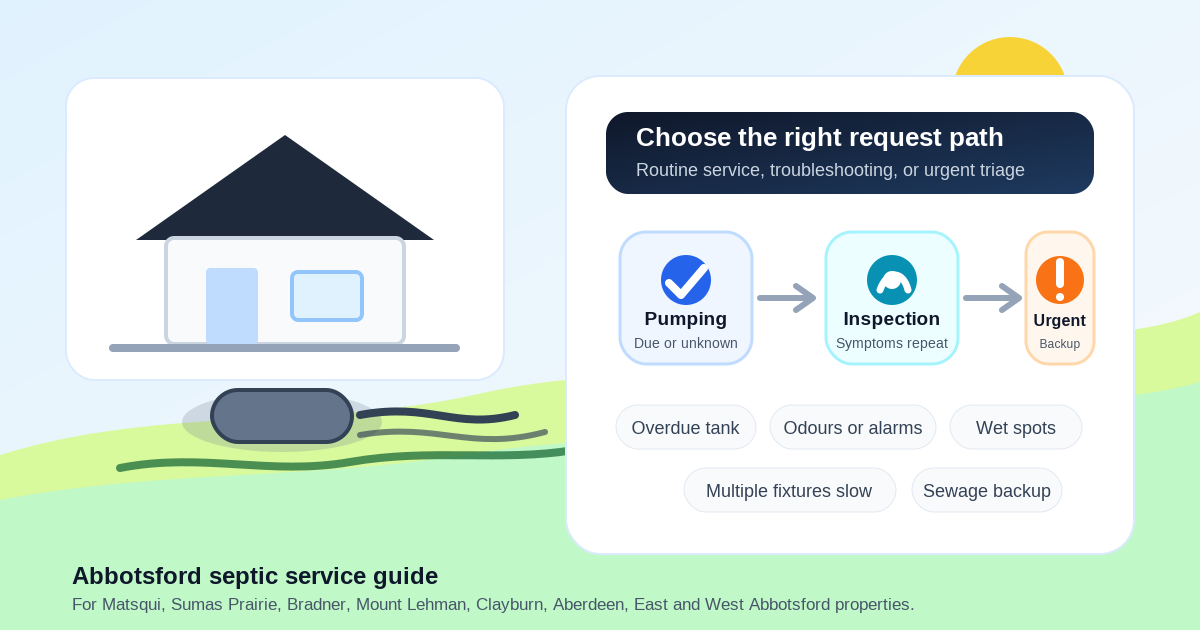
Homeowners in Matsqui, Sumas Prairie, Bradner, Mount Lehman, Clayburn, Aberdeen, East Abbotsford, and West Abbotsford often search for septic tank pumping first because it is familiar. Pumping can be the right first step, especially when records are missing or the tank is overdue. But odours, wet spots, alarms, and repeated drain issues often deserve septic inspection and troubleshooting instead of another routine pump-out.
If sewage is backing up indoors, wastewater is surfacing outside, or several fixtures stop draining at the same time, do not treat it as a normal maintenance question. Use the emergency septic service path or call for the fastest triage.
Quick decision guide
Maintenance is due or the service history needs review, and there are no current drainage, odour, wet-field, or alarm symptoms. Share unknown records rather than assuming pumping alone is enough.
There are sewage odours, wet or unusually green field areas, alarms, recurring slow drains, or symptoms that returned after recent pumping.
Sewage is backing up, multiple fixtures fail together, wastewater is surfacing, or the problem is getting worse right now.
When septic tank pumping is the right starting point
Pumping is a practical service to discuss when your maintenance plan says it is due and the system is stable. If the interval or service history is unknown, request a maintenance review and explain what records you have. A pump-out removes accumulated material; it does not establish that every part of the system is working properly.
- The last confirmed pump-out date is old or unknown
- You are a new homeowner trying to establish a maintenance record
- The system seems stable but you want to reduce guesswork before symptoms escalate
- No current drainage, alarm, odour, or wet-field concern has been noticed
If this sounds like your situation, start with the Abbotsford septic tank pumping page and include tank access details, driveway notes, and the last known service date in the request.
When inspection or troubleshooting should come first
Inspection becomes more important when the problem is unclear or keeps coming back. A tank can be pumped and still leave another issue unresolved, especially when symptoms involve the field, pump components, alarms, or repeat plumbing trouble.
- Sewage odours around drains, the tank area, or the yard
- Wet, soft, or unusually green patches near the suspected septic field
- Alarm lights, pump concerns, or recurring problems after heavy rain
- Slow drains in more than one part of the home
- Symptoms that returned after a recent pump-out
For those clues, use the septic inspection and troubleshooting lane. The goal is not to force a complicated service call; it is to avoid treating every symptom like routine maintenance when the system may need a clearer look.
When the issue is urgent instead of routine
Some symptoms should be handled as urgent triage rather than a normal pumping-or-inspection decision. If the problem is active and worsening, stop heavy water use where practical, keep people and pets away from contaminated areas, and get the details into the request or phone call.
- Toilets, tubs, showers, or floor drains are backing up
- Several fixtures stop draining at the same time
- Wastewater is surfacing outside
- There is strong sewage odour with active plumbing trouble
For these symptoms, use the emergency septic service guidance and call for the fastest triage. Share the address, affected fixtures, outdoor symptoms, and whether the problem is worsening when water is used.
What if only one drain is slow?
One slow sink or shower does not establish that the septic tank needs pumping. A local plumbing restriction is another possibility. Tell the service team which fixture is affected and whether other fixtures drain normally; they can help clarify whether plumbing follow-up or septic troubleshooting is the appropriate next step. Do not run extra water to test a system that is backing up.
Before booking: confirm what the visit will cover
“Pumping” and “inspection” are not interchangeable scopes. Explain your main concern before agreeing to a visit, especially if symptoms returned after a recent pump-out. Ask:
- Is the proposed visit routine pumping, symptom troubleshooting, or a defined inspection?
- Which parts of the system will be assessed, and what will remain outside the scope?
- If pumping is needed to support the assessment, how will the sequence be decided?
- What tank-location records, lid access, and driveway information should I provide?
- Will I receive findings and recommended next steps, and how will any additional work be agreed?
A property-purchase inspection is a separate planning question: mention the transaction and deadline, and read the pre-purchase septic inspection checklist. Do not assume a routine pump-out receipt meets a buyer’s requirements.
When fall rain changes the request
If symptoms appear after rain, include that timing, but do not assume rain proves the cause. Describe standing water, soft access routes, and whether the tank or field area is flooded. Do not open the tank, drive over the field, or arrange routine pumping of a flooded system without professional direction. The heavy-rain septic guide covers that situation in more detail.
What to include so the request can be triaged properly
The online form is most useful when it explains the property and symptoms in plain language. You do not need to diagnose the system yourself. Send the clues that help separate routine pumping, inspection, maintenance planning, and urgent triage.
- Your Abbotsford area, such as Matsqui, Sumas Prairie, Bradner, Mount Lehman, Clayburn, Aberdeen, East Abbotsford, or West Abbotsford
- Last known pump-out date, even if it is only an estimate
- Whether tank lids are visible or still need to be located
- Current symptoms: odour, wet spots, alarms, slow drains, backups, or recent changes after rain
- Access notes such as long driveway, gates, livestock, soft ground, slope, or parking limits
- Whether the issue is active right now or something you are planning ahead for
If the system seems stable and you are mainly trying to plan ahead, the septic maintenance page and the acreage pumping frequency guide are good supporting reads. If you recently bought the property, the new homeowner septic checklist can help organize records before you request service.
A short service request you can adapt
My property is in [Abbotsford neighbourhood]. I am requesting [routine maintenance or help with symptoms]. The last confirmed pump-out was [date or unknown]. I have noticed [affected fixtures, alarm, odour, or outdoor symptoms] since [time]. The issue is [active now or intermittent], and [did or did not] return after recent service. Tank location and access are [known details or unknown]. Please confirm the appropriate service scope and availability.
Use those prompts in the online service request for non-urgent planning. You can also organize records with the printable septic service history worksheet. A submitted form is a request, not a confirmed booking. For active sewage backup or surfacing wastewater, call rather than waiting to complete a checklist.
Not sure which Abbotsford septic service to request?
Use the request service form and describe the symptoms in plain language. If sewage is backing up, wastewater is surfacing, or several fixtures are failing together, call (778) 312-3314 for the fastest triage.